
BOMBANANA Gameplay Modes, Roles, and the Bomb Loop
Learn BOMBANANA gameplay through its three-player role split, Campaign, Endless, Custom modes, bomb modules, and a safe communication loop for new teams.
FAQ
What is BOMBANANA! gameplay like?
Which BOMBANANA! mode should a new team choose?
The short answer
BOMBANANA! gameplay is a three-player online co-op bomb-defusal relay. The Blind Monkey operates the bomb, the Mute Monkey reads the defusal manual, and the Deaf Monkey sees the game world and speaks without hearing voice chat. The team succeeds by carrying one correct instruction through those limits before the timer or mistake allowance runs out.
The full game has three modes. Campaign contains 30 handcrafted levels with increasing difficulty, Endless creates procedurally generated wave-based levels that become harder, and Custom lets the team adjust bomb difficulty, explosion timers, module types, environmental hazards, and allowed mistakes.
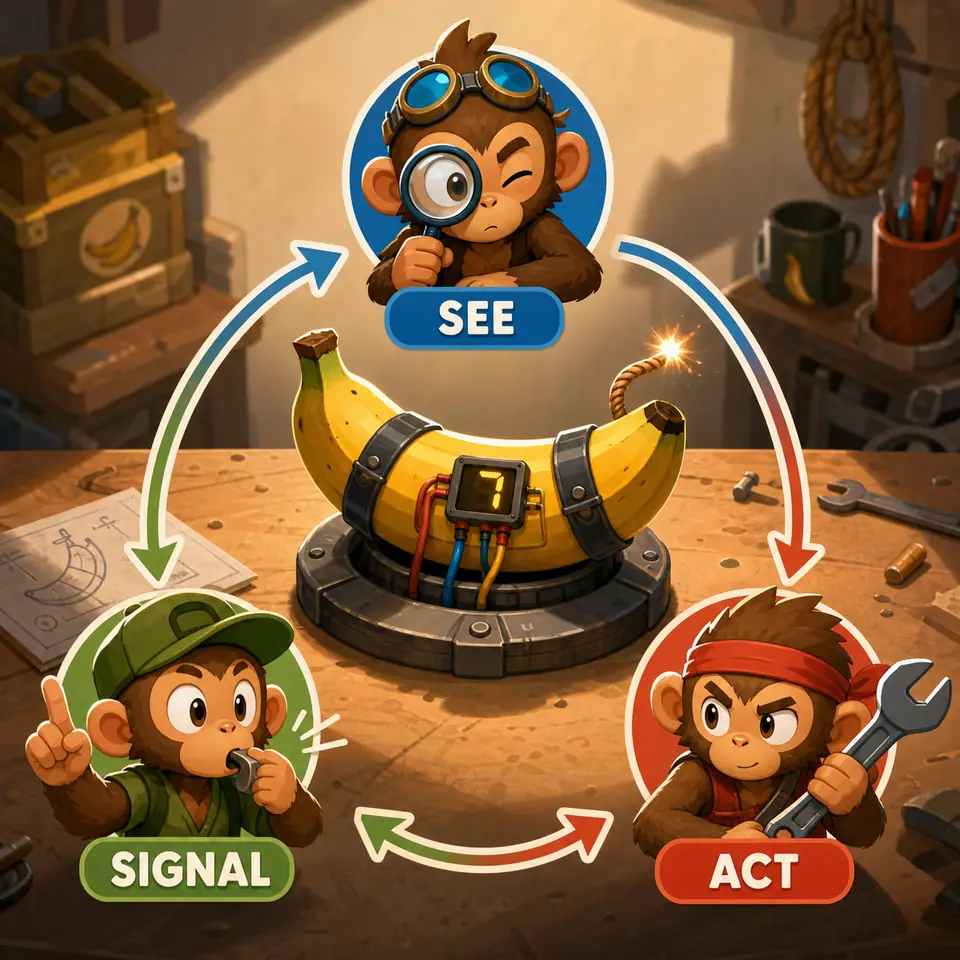
This diagram explains the basic gameplay rhythm. It is an editorial visual, while the live bomb and current manual remain the authority for a particular module.
Why the roles shape every round
The three roles divide information as well as controls. The Blind Monkey can touch the bomb but cannot depend on visual colors or text. The Mute Monkey can read the rules but cannot speak the answer through normal voice communication, and the Deaf Monkey can see and speak but cannot hear the conversation.
That division means a player should report the clue their role can actually verify. The bomb handler can describe a tactile count or position, the visual player can report colors, lights, or displayed values, and the manual reader can match those facts to a rule. No player should fill a missing clue with a guess because the team needs the whole packet before it acts.
The role page explains the limits in detail, so read BOMBANANA! Blind Deaf Mute roles before comparing modes. Gameplay becomes easier to understand once each player knows which information belongs to them and which information has to arrive from a teammate.
The core gameplay loop
Every module benefits from the same five-step rhythm. Identify the module, report the state that matters, let the manual reader choose the rule branch, repeat the final action, and interact only after confirmation. After the input, check whether the module solved or changed and start a fresh report when the state moves on.
The first call should be short. A wire report can start with its count and color order, a direction report can separate its number clue from its light, and a switch report can give every current position. The exact answer depends on the current manual, so the team should preserve the input rather than announce a permanent answer from memory.
The communication guide turns this loop into a team vocabulary. Agree on yes, no, repeat, stop, left, right, and solved before the timer begins, then test the perspective used for physical positions.
Campaign gives the clearest introduction
Campaign is the structured mode for teams learning the game. Its 30 handcrafted levels become progressively more difficult, giving the group a common route through the game instead of asking it to create a challenge immediately. Older Demo coverage describes a seven-tier progression, which is separate from the full Campaign count.
Use the early levels to make the communication loop boring. One player should name the module, one should own the rule lookup, and one should repeat the final action. If a wire or direction call fails because of a left and right mismatch, fix the vocabulary before moving on to a harder bomb.
The full launch announcement confirms the level count and the three-mode structure. It does not publish a permanent public solution table for every module, so Campaign should be treated as a place to learn current rules from the live game. The levels guide separates confirmed progression facts from older Demo reports.
Endless tests a stable team
Endless uses procedurally generated, wave-based levels that keep getting harder. That structure changes the team’s problem from learning one authored route to preserving its callout habits as the next bomb or module mix changes. It is a better fit after the group can complete a clean handoff without debating every word.
Endless also makes recovery habits important. When a module changes, read the current display again and do not keep using the previous answer. When an environmental hazard interrupts communication, use the agreed stop signal, restore the missing state, and then continue from the last confirmed point.
The official launch material mentions new environments, hazards, and modifiers. It does not define every hazard pattern or tell players which module appears in each procedural wave. Those details are To be confirmed until the current build provides a stable rule that can be checked.
Custom controls the practice problem
Custom lets the team make a challenge by adjusting bomb difficulty, explosion timers, module types, environmental hazards, and how many mistakes are allowed. This makes it useful for focused practice because a group can change one condition and see whether that condition caused the failure. It also gives experienced teams a way to create a pressure test without waiting for a particular Campaign level.
Start with one module family when a team is learning. Give the group enough time to finish the callout and keep the allowed mistakes generous while the vocabulary is still changing. Add another module or reduce the time only after everyone can say where the previous attempt broke.
Custom is also a good place to rotate roles. The player who usually handles the bomb can try the manual, and the player who usually speaks can practice receiving a visual or gesture signal. That rotation does not change the official role limits, yet it helps the trio understand why an instruction that sounds clear to one person can be unusable for another.
Launch features that affect gameplay
The official launch announcements describe 14 new puzzle modules, split into 11 standard modules and 3 CHAOS modules. They also list new environments and hazards, a global lobby browser, room codes, emotes for everyone, voice-synced mouth animations, controller support, Steam Deck support, achievements, and colorblind modes.
The launch feature list describes what was added to the game. It does not make every individual module rule public, and it does not turn a community screenshot into a universal answer. Use the puzzle modules page for the current fact boundary and the latest update page for the dated announcement record.
Who should play BOMBANANA!
BOMBANANA! fits a group that enjoys social deduction, limited information, and improving its shared language. The most satisfying progress comes when a long, confused description becomes a short packet that every player understands. The game’s pressure comes from communication as much as from the module rule.
A player looking for a solo puzzle campaign, a confirmed two-player mode, or an open voice channel for every role should keep expectations careful. The launch information confirms the three-player online design and does not confirm solo, local split-screen, or four-player scaling. For access and platform facts, use BOMBANANA! on Steam.
A reliable first session
Bring three players into the same session, assign the roles, and choose a small signal vocabulary. Start with Campaign, name each module before its details, and let the manual reader return only one action at a time. If the team fails, change one convention before retrying.
Read BOMBANANA! guide for the first-run checklist. Use BOMBANANA! manual when the group needs the rule handoff, and use BOMBANANA! online co-op when the question is about lobby size or remote play. The basic gameplay rule stays the same throughout. Preserve the current state, confirm the next action, and then touch the bomb.
Related Articles
guides
BOMBANANA Guide for First Runs, Roles, and Bomb Tips
Use this BOMBANANA guide to prepare three players, understand the Blind, Deaf, and Mute Monkey roles, choose Campaign, and build safe callouts.
guides
BOMBANANA Blind Deaf Mute Roles Explained
Learn the BOMBANANA blind deaf mute role split, what each player can access, and how three teammates pass information safely before acting on a live bomb.
communication
BOMBANANA! Communication Guide for Three-Player Co-op
Build clear BOMBANANA! callouts with voice, text, and gestures so the Blind, Deaf, and Mute Monkey roles can combine partial information under pressure.
Was this helpful?
Thanks for the feedback!