
BOMBANANA Math Module: Calculator Relay Guide
Handle the BOMBANANA math module with a clean calculation, state check, manual lookup, and confirmed input while exact answer tables remain To be confirmed.
FAQ
How should a team handle the BOMBANANA! math module?
Is there a verified universal math answer table?
The short answer
Treat the BOMBANANA! math module as a staged calculation and communication problem. Read the expression, light or state information, and requested input separately, calculate the raw result, and then check whether the game asks for another lookup before entering anything. A correct calculation can still fail when the team skips the second stage or sends a result in the wrong form.
The calculator panel belongs to a three-player chain. One player can report the physical or tactile interaction, one reads the manual, and one speaks the visual information or relays the final action. The team should keep the expression, the intermediate result, and the final input as separate pieces of information.
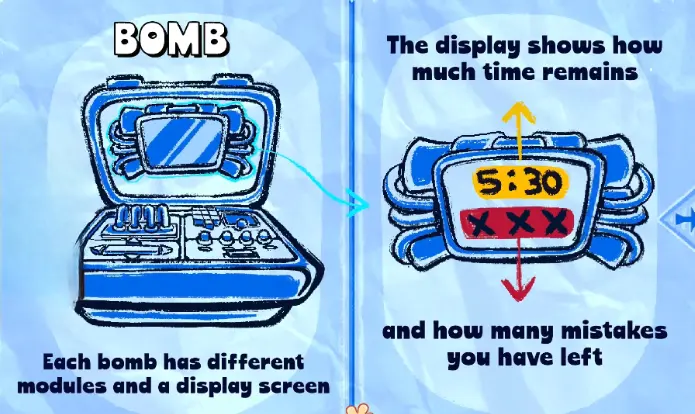
This image is a visual reference for the pressure around every module. It shows why the timer and remaining mistakes matter, without establishing a math solution for the current build.
Read the entire input packet
Start by naming the module as a calculation or keypad panel. Then report the displayed expression exactly, including the order of digits and operators. If the panel also shows a light, number, symbol, or requested input type, report that state separately instead of blending it into the arithmetic sentence.
Separate the expression, light state, and requested input. That separation prevents a player from treating the first number they see as the final answer. It also gives the manual reader enough context to determine whether the raw result is the next input or only a key for a second rule.
Read multi-digit values digit by digit when the voice channel is busy. Ask for a repeat when one digit is uncertain, and use a fixed left-to-right convention for any row of values. A fast calculation based on a misheard digit has no value once it reaches the bomb.
Expect a possible second stage
The calculator can change state after the raw result is entered. The first step starts as arithmetic, then the panel can turn that result into a second lookup. That is why a team should never assume that the arithmetic result itself is automatically the final key.
After entering an intermediate value, stop and read what the panel shows now. A new light, label, number, or prompt creates a new state packet, and the manual reader must match that packet to the correct rule. If the display changes, the old answer no longer describes the current panel.
Keep the intermediate result visible in the team’s shared notes if the game allows it. Label it as a raw result rather than a confirmed action. This small wording choice prevents the bridge from repeating an unfinished answer as if it were the key that the Blind Monkey should enter.
Give each role a narrow job
The Blind Monkey is the player associated with touching and operating the bomb, so the final input needs a clear physical description. The Mute Monkey reads the manual and should reduce the rule to one next action. The Deaf Monkey sees the panel and can speak, which makes this role useful for reading visual state and translating the Mute Monkey’s gesture into an instruction.
Do not let the manual reader announce a long calculation chain through gestures. Send the expression as one packet, the raw result as another, and the final action as a third. The bridge can confirm each piece before the handler moves to the next stage.
Use one phrase for an intermediate result and another for a final input. For example, “raw result recorded” can mean that no key should be pressed yet, while “final key confirmed” can release the handler to act. The exact words are a team convention, so test them before the bomb starts counting.
Separate rule failure from relay failure
When a calculator attempt fails, first ask whether the arithmetic was wrong or whether the state packet was incomplete. A missing light color, an omitted operator, or a reversed digit can send the manual reader to the wrong branch even when everyone is good at arithmetic. A correct raw result entered at the wrong stage creates the same failed-run feeling.
The June 16 official hot fix corrected wrong information in the Italian Calculation Module manual page. That update is evidence that manual text can be a source of confusion, yet it does not prove that the module’s underlying logic is broken. If the numbers look inconsistent, confirm the manual language, the selected module, and the current display before reporting a new defect.
A useful retry changes one variable. Read the expression again if the first value was unclear, mark the raw result if the team skipped the stage boundary, or assign one player to read the new display after the input. Repeating the same unexamined callout only gives the same error another chance to happen.
Exact answers remain To be confirmed
The available module guidance explains how to report a calculation panel and preserve the result through a second lookup. No primary, release-stable table covers every expression, light state, and final key. Any complete formula copied from a single Demo screenshot or community solver is To be confirmed for the current game.
That boundary keeps this page useful without pretending to be a complete reference sheet. Use the live manual for the branch that matches the current panel, and record the build if your team finds a repeatable difference. A dated observation can become a future verified rule after it is checked against a primary source.
Practice the handoff
Campaign lets a new team build the basic relay in a structured progression. Custom can help when the group wants to isolate a module, adjust the timer, or control module types and allowed mistakes. Use the game modes guide to choose a practice setting.
Before starting, agree on the order for expression, state, raw result, second display, and final key. During the run, allow the handler to say repeat or stop before entering an uncertain digit. After the run, write down the exact point where the number changed meaning.
For the wider manual process, read BOMBANANA! manual. Compare the direction module guide and switch module guide when your group struggles with state changes, since those pages use the same rule of reading the current panel again before acting.
Related Articles
modules
BOMBANANA Direction Module: Braille and Lights
Read the BOMBANANA direction module by separating the Braille or number clue, light state, direction language, and final confirmed arrow input.
modules
BOMBANANA Manual: Role Flow and Callout Rules
Use the BOMBANANA manual guide to route module clues through the Mute Monkey, Deaf Monkey, and Blind Monkey without relying on an unverified answer sheet.
modules
BOMBANANA Wires Guide: Read Colors and State
Use this BOMBANANA wires guide to report wire count, color order, indicator state, manual branch, and the final physical position before cutting.
Was this helpful?
Thanks for the feedback!