
BOMBANANA Manual: Role Flow and Callout Rules
Use the BOMBANANA manual guide to route module clues through the Mute Monkey, Deaf Monkey, and Blind Monkey without relying on an unverified answer sheet.
FAQ
Which BOMBANANA! role reads the manual?
Is this an official BOMBANANA! PDF manual?
The short answer
The BOMBANANA! manual is the rule layer in the bomb-defusal team. The Mute Monkey reads the manual, matches the current module state to a rule, and sends one action through a visual signal. The Deaf Monkey translates that signal into a spoken instruction, and the Blind Monkey performs the confirmed input on the bomb.
This page is a workflow guide rather than a claimed official PDF. An official downloadable manual book, retail rulebook, or permanent answer sheet for every module and build is not verified. Use the current in-game manual for a live panel and treat detailed mappings as To be confirmed when the available evidence does not settle them.
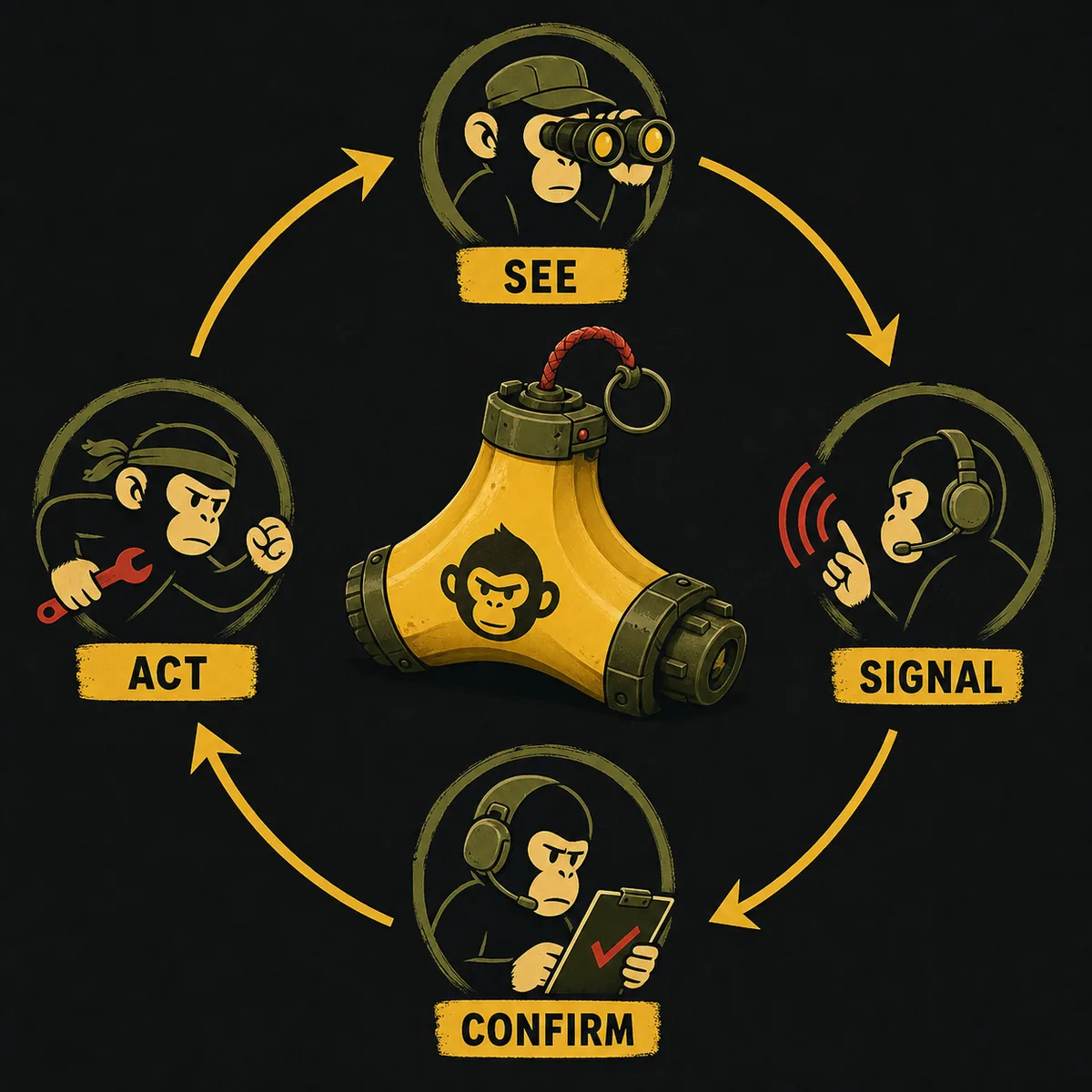
The diagram shows the useful rhythm of the manual. It is an editorial visual and does not replace the live game’s current rule page.
What the manual reader should do
The Mute Monkey should read for decision points. Start by identifying the module, then isolate the clue that changes the answer, such as wire count, color order, light state, number, direction, switch position, or a visible label. Once the relevant state is complete, choose the next action and communicate only that action.
Long explanations create a second puzzle. The Deaf Monkey has to see the gesture, interpret it, and say it to the Blind Monkey, so a page of rules is too much to pass as one signal. A short sequence of module, state, action, and confirmation is easier for every role to audit.
If one clue is missing, ask for that clue directly. The Mute Monkey should not fill a blank with an answer from the previous bomb, and the Blind Monkey should not press because the timer feels urgent. A visible repeat or stop signal gives the team time to restore the current state.
A stable manual callout order
Use the same broad order for every module. Name the module, identify its position if several panels are present, report the elements in a fixed reading order, include the indicator or feedback state, ask one question, and send one confirmed action.
The communication guide expands this into a team protocol. The point of the order is to make the manual search predictable, so the reader does not have to remember whether a color, digit, or switch state was mentioned before the module name.
For wires, report the count first, then colors from left to right, followed by the indicator state. For a direction panel, keep the Braille or number clue separate from the light and agree on the meaning of left and right. For a keypad or calculation panel, separate the displayed expression from the state and requested input.
For a switch panel, report every current position and keep the final confirm or Enter action separate. A changed panel starts a new packet, even when the previous manual decision was correct. The switch module guide gives the state-tracking version of this process.
How the roles carry the manual answer
The Blind Monkey operates the bomb and needs a physical target. A manual result such as a color, number, or direction must be translated into a position or input that this player can identify. The handler should repeat the final instruction and wait for confirmation before touching the control.
The Mute Monkey owns the manual rule. This role should signal a single action or request for a missing clue, not a complete paragraph of reasoning. If the rule requires several steps, send them as separate confirmed actions so the team can check the panel after each change.
The Deaf Monkey sees the bomb and can speak, yet cannot hear the voice channel. This role supplies visible information to the manual reader and speaks the Mute Monkey’s gesture to the Blind Monkey. The group should reserve a signal or text method for confirming that a spoken instruction was understood.
Manual topics by module family
The module references describe four useful reporting families. Wire modules use count, color order, and indicator state. Direction modules combine a Braille or number clue with a light and an arrow, while calculation panels separate arithmetic from a possible second lookup.
Switch modules use a complete ordered board state. Record the starting arrangement, identify whether the rule asks for a sequence or an end state, flip one control, and verify the new arrangement. The wires guide, direction module guide, and math module guide keep their own uncertainties separate from this shared manual flow.
The official launch announcement describes 14 new puzzle modules, including 11 standard modules and 3 CHAOS modules. It does not publish a complete rule catalogue in the announcement. Exact names, answer rows, timers, and release-specific variations are To be confirmed when the live manual or another primary source does not verify them.
Manual PDF and book searches
Search results for a BOMBANANA! manual PDF can point to a fan guide, a screenshot, or an unrelated download page. An official downloadable PDF, physical manual book, or retail bundle is not verified. A page that promises a complete answer sheet should not be treated as official merely because it uses the game name.
Use the official BOMBANANA! Steam page for the game and current store information. Keep any community notes tied to their build and module state, and do not turn a copied table into a site-wide fact until it has a primary confirmation.
How to practice the manual
Start in Campaign, where the 30 handcrafted levels offer a structured progression. Give the Mute Monkey enough time to locate the rule, then have the Deaf Monkey repeat one action and the Blind Monkey confirm the physical input. Speed can come later, after the group can identify which clue was missing in a failed run.
Custom is useful when the team wants to focus on one module family or adjust bomb difficulty, timers, environmental hazards, and allowed mistakes. Rotate roles after the basic callout vocabulary works, and change one convention at a time. A practice run should teach the team which wording makes a rule usable.
What the manual page does not claim
This page does not claim a permanent solution for every wire, math, direction, switch, or launch module state. It does not provide an official PDF, a physical book listing, or an invented code sheet. It gives the team a safe way to move a current state through the manual and labels unresolved details To be confirmed.
Read BOMBANANA! guide for the first session, BOMBANANA! gameplay for the three modes, and BOMBANANA! latest update for dated launch and hot-fix notes. The manual becomes useful when it produces one checked action, not when it produces the longest explanation.
Related Articles
guides
BOMBANANA Guide for First Runs, Roles, and Bomb Tips
Use this BOMBANANA guide to prepare three players, understand the Blind, Deaf, and Mute Monkey roles, choose Campaign, and build safe callouts.
guides
BOMBANANA Blind Deaf Mute Roles Explained
Learn the BOMBANANA blind deaf mute role split, what each player can access, and how three teammates pass information safely before acting on a live bomb.
communication
BOMBANANA! Communication Guide for Three-Player Co-op
Build clear BOMBANANA! callouts with voice, text, and gestures so the Blind, Deaf, and Mute Monkey roles can combine partial information under pressure.
Was this helpful?
Thanks for the feedback!